       |
| |
 ...
Antenna Assembly
...
Antenna Assembly
| The antenna is composed of all brass components, starting with a bent perforated sheet soldered to a wire. The wire is inserted into two disks that act as hinge wheels. An axle rod fixed to the top shell with a generous dollop of grey plumber's epoxy fits though center holes in the disks. Lastly, a pin inserted into one of the disks acts to stop the antenna swing when it hits the top shell's inner surface: |
|||||
| Perforated Brass Sheet |
|||||
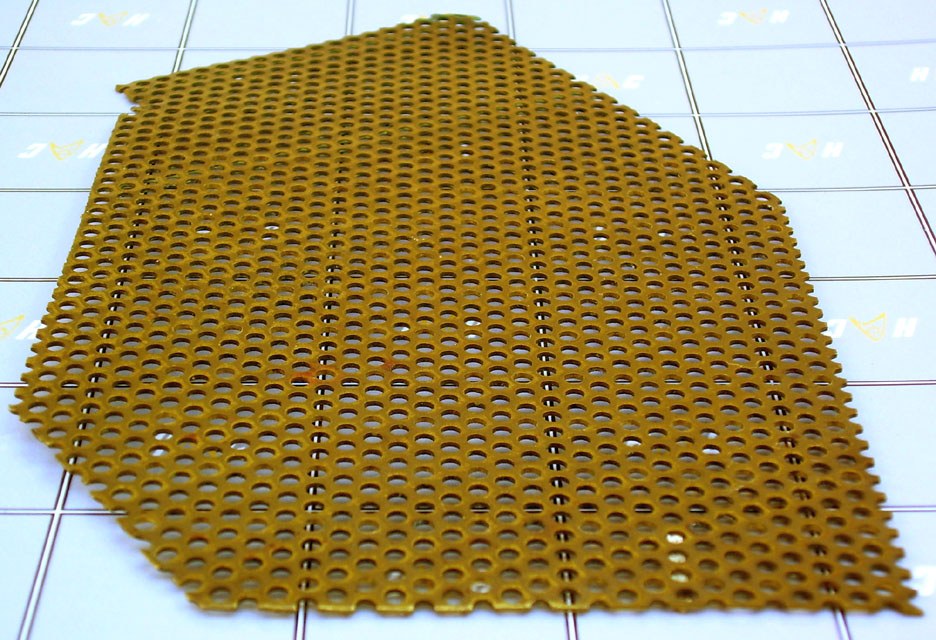
| The basic specs of the brass sheet installed in Wah's communicators are: Thickness: 0.027" average (varies between .025 and .029, depending on where the micrometer is placed) Hole Diameter: 0.078" (5/64") Hole to Hole spacing: 0.125" staggered Earlier we had a chance to examine, thanks to William Krewson, author of a 1995 Cinemafantastique Magazine article on Wah, the largest of the last remaining unused portions of the perforated brass sheet that went into the antennas. Photographs of the roughly 3"x6" sample, including a full size scan (at 300 dpi) on the right, are as follows: |
|||||
|
|
|||||
|
Common brass sheet today is made from the alloy C26000, known as "cartridge brass." It is 70% copper and 30% zinc, with a few other allowable trace elements. Every replica today has this standard alloy in its antenna. But is that the right stuff as found on authentic comms? We commissioned a chemical assay that vaporized a tiny bit of our sample, and the answer is a surprising "not quite."
The alloy Wah used is actually C26800, a grade of "yellow brass" whose standard composition is a nominal 66% copper and 34% zinc. Side by side, the technical specifications of the two materials are:
C26000
C26800 Given that C26800 alloy is going to be exceedingly difficult to obtain in thin sheet form, the big question for hobbyists is... does it make any difference? Color-wise, are they dissimilar enough to warrant the extra effort to try to find it? From what we've seen, happily no. That small remnant from Wah has been matched up against a modern sheet of perforated cartridge brass, both as polished and mildly weathered, and it was very hard with the naked eye to see any difference at all. Where
to get: Readily available from online/hobby/hardware stores is cartridge brass sheet at 1/32" (0.032") thick. That's fairly close - about 16% over - and that might do for many hobbyists, but the greater depth can make the holes appear smaller when viewed at an angle. If, however, you can find brass stock closer to 0.025, you'll likely be happier with the end results. To guide your drilling (hopefully using a drill press) forget using a center-punch to hand-mark all the 435 (29 rows of 15) hole centers (find here a template illustrating that pattern). Instead, obtain from McNichols or Accurate Alloys a small steel perforated sheet with the correct hole and spacing size and bolt it on top of your brass. Stack perhaps four to six brass sheets to maximize your hours of efforts. Have as your bottom sheet a piece of waste brass or aluminum, as the last sheet's holes tend to end up being a ragged mess. Now it's never been our intent to offer tutorials on how to build replicas, but we can at least share some helpful hints.... 1. Prep your holes. On Wah’s brass, the top surface has the hole edges softened with a slight roundness, whereas the underside the hole edges remain crisp and sharp:
This edge rounding, created by the punching action, can be somewhat replicated (after you’re done drilling) by cleaning your underside surface with fine-grit sandpaper but the top side with steel wool (0000 superfine); allowing the steel fibers as you’re rubbing to press in and abrade around the holes a good bit. For both ease and uniformity you’ll naturally want to do this while the sheet is still flat. 2. Cut your sheet to the correct size. Wah was somewhat inconsistent with his antenna trimming, and in his rush he wasn't at all concerned about keeping the holes symmetrical left/right or front/back, as you can see below. But you may be.
Suffient photo evidence exists to determine the initial flat measurements for nearly all of his antenna sheets: |
|||||
|
width (in.) 1.72 |
length (in.) 2.98 |
# of complete rows 27 |
||
Thus if your aim is for a quintessential comm, your antenna sheet should start out 1.70" wide x 2.99" long, with a total of about 13.5 holes across, and up/down 27 complete rows, plus a partial fraction of a row both in the back (leaving a mildly-jagged rear edge) and up front (filled in if you like with solder):
3. Get your bends right. Note how the side bend is different from the more rounded front, which is then different from the flatter rear:
4. Build a set of jigs (as pictured below) for holding in a bench vise to bend those edges. The 3” jig is for the long edges, which are done first, and the shorter 1-1/4” jig is of course for the two ends. The brass slots into the jigs' side notch, and the rounded corner has about a 1/8” radius. Put the jig in a vise with the top equal to the top of the vise. The sample brass strip in the pic is taped on in to illustrate that bending. A final word - the short jig also has rounded end corners.
To get that full front bend curve, don't slip the antenna sheet in all the way. Put it in incrementally, a bit at a time, bending it a little with each go. 5. Have your antenna wire formed in advance to the correct size so you can match up your bent antenna sheet to fit atop it. Be sure to complete all bends, including the ones at the back for fitting into the hinge wheels. Adding them after will have you cracking your new solder joints there (trust us). That back bend, by the way, has a steep angle - shoot for 60 degrees. 6. Use ONLY nylon-tip jewelry pliers, available at A.C. Moore or HobbyLobby, to tease down and round the perforated sheet corners. Steel pliers will badly gouge the brass, and you will hate yourself after (trust us). 7. To form the tight bends in the front, you may need to cut out some teeny-tiny bits of brass to allow the holes to deform and shrink down. Otherwise there’s too much material left and the brass will start to squish outward. This hole-trimming is not evident in the Wah comms we've seen, but then his antennas do squish out some, and you may want your replica to be more tidy. Note in the photo below how this replica did it:
8. Firmly secure prior to soldering the brass wire to your formed antenna using the thin, strong steel wire found in your average grocery store twisty-tie. Just peel the paper away and the stuff is perfect for holding tight (twisted with pliers) the parts together. 9. Solder using a butane pencil torch. Don't be intimidated by this; if you're crafty enough to have done the others steps above, you'll find flame soldering easy enough.
Use plumbing "silver bearing" solder, and be sure to apply some liquid flux to prevent the surface oxidation of the brass during heating that might otherwise prevent the solder from sticking. Hold the antenna assembly aloft with hobby "helping hands." Place the solder bits along the antenna wire on the inside and slowly apply the flame back-and-forth from below (the outside of the assembly), as solder flows toward the heat source. This orientation best draws the molten solder into the seam, yet leaves barely any solder visible from the outside. Done gently and steadily enough, the solder bits will reach their melting point at the same time, and suddenly they'll all go in a single stroke of the flame, like a zipper, and you're done. Prior to heating, wick any excess liquid flux away with the tip of a tissue or a cotton ear swab, as any remaining drops will boil, and the bubbling action can displace the flecks of solder you've carefully placed. 10. And two more hints for soldering… first, use way less solder than you think you need. If your fit between the antenna perf and the wire is tight, the itty-bittiest of solder in any given spot is enough. Also, solder does not flow over model paint, so if you want to control where the solder goes - or more accurately where it doesn’t - apply a little Testors there first. The paint holds up under the soldering flame yet comes off after easy with some thinner. 11. Solder on the hinge wheels last. 12. Your entire assembly will have oxidized from the heat, so buff the whole thing inside and out with 0000 steel wool. 13.
If you want to stop the oxidation of the brass, try
on your finished assembly an artistic matte fixative spray, like what
you'd apply over a fresh charcoal drawing you don't wish to smudge.
This method has been used so far on just a couple replica comms
we've seen, but those results have to date been good. |
|||||
| Brass (or Steel) Wire | |||||
|
Do know steel wire is much, much harder to bend than brass. Where
to get: |
|||||
| Hinge Wheels | |||||
| A 5/8" (0.625) diameter brass rod cut to make nominal 1/8" wide discs. Widths vary on the comms we have measurements of from about 0.115 to 0.135 inches, so figure the average is spot on 0.125." A 1/8" diameter hole is drilled in the center to accommodate the axle rod (see below). The 1/16" hole for the antenna wire is drilled straight down perpendicular, and can go clear through to the center.. Where
to get: |
|||||
| Axle Rod | |||||
|
Where
to get: |
|||||
| Stop Pin | |||||
| We've seen two types and sizes of metal pins. In Epsilon and Zeta, it is likely steel, probably 3/32" (0.094) diameter and cut to about an 11/32" length. In Alpha, it is brass or copper 1/16" (0.063) diameter wire snipped to a maximum length of 5/16" with a pair of wire cutters (as presumed by the pointed beveled end). Where
to get: |
|||||
| Star Trek is a Registered and Copyrighted Trademark of Paramount Pictures. All Rights Reserved. All subject matters referring to Star Trek are trademarks of Paramount Pictures. This website has not been produced or endorsed by Paramount Pictures. Any material belonging to Paramount’s Copyrighted Material that may appear on this site complies with fair and/or acceptable use for the purposes of review, study, criticism, or news reporting. |




 A
1/16" (0.063) diameter rod or wire. Most comms we see use
brass, but probably two so far, certainly
A
1/16" (0.063) diameter rod or wire. Most comms we see use
brass, but probably two so far, certainly  A
1/8" (0.125) diameter brass rod cut to a length of 2.00"
A
1/8" (0.125) diameter brass rod cut to a length of 2.00"