|
| |
 ... The Sterling Pencil Box
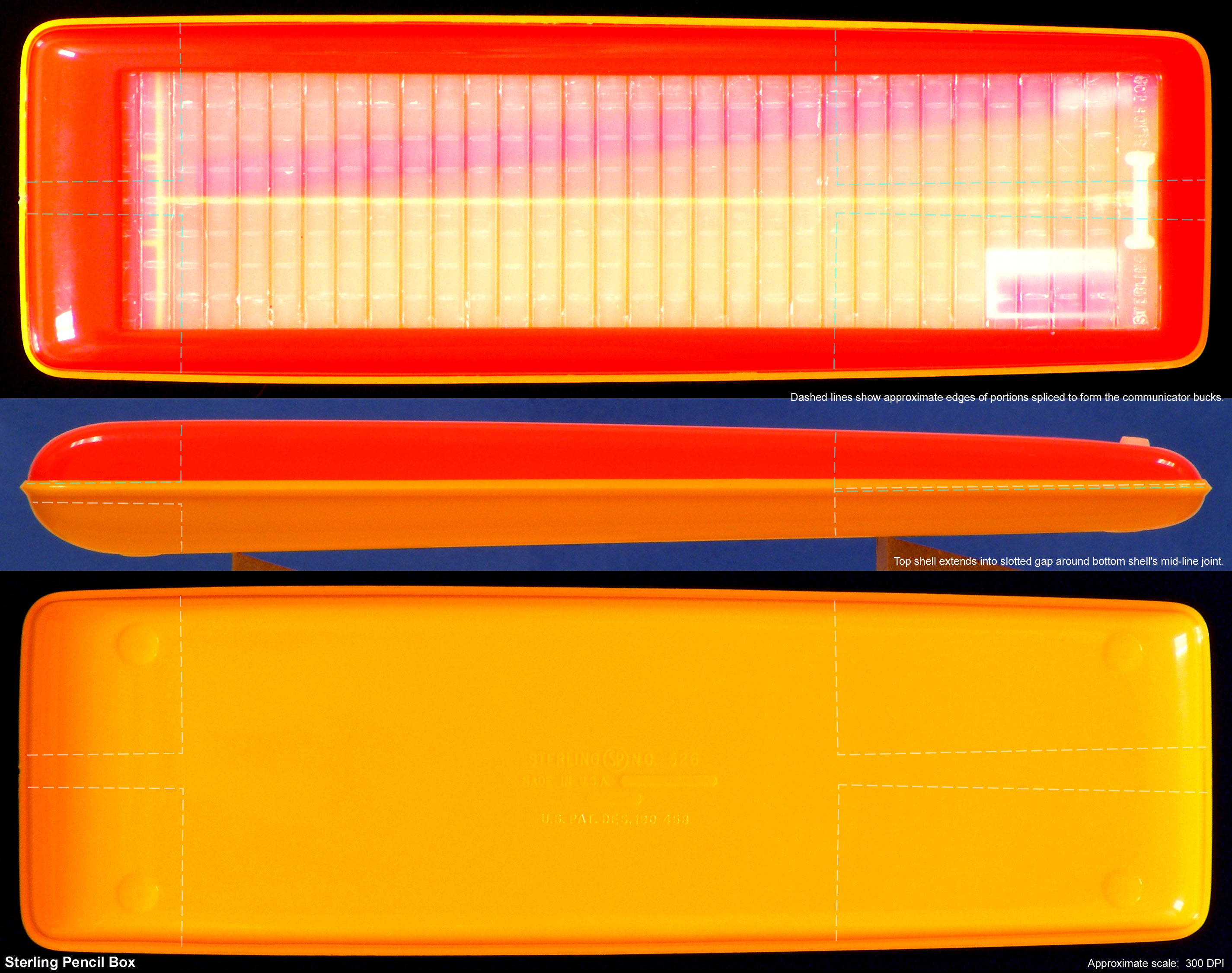
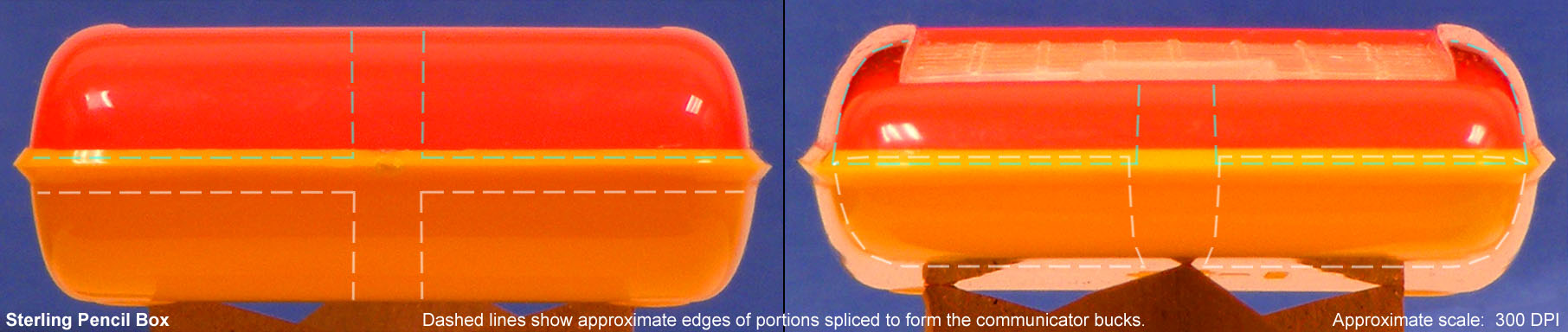
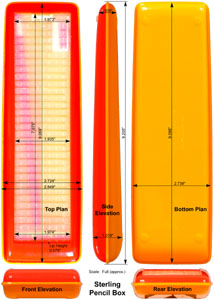
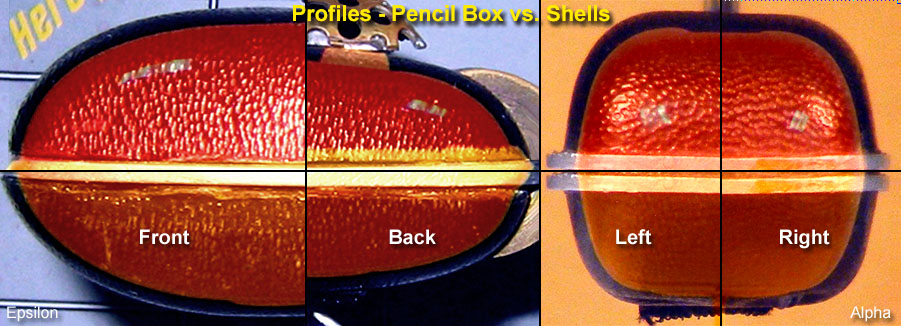
| Building upon the earlier extraordinary discovery that Wah Chang created the bucks for his communicator shells from a plastic Sterling Co. pencil box (the story of that detailed on this page), we have next investigated the way pieces of that box were assembled. Using photographs sized to scale and comparing them to similarly scaled comm pics and tracings, we demonstrate here how all of the features seen in the shells, including the top well imperfections (or "wanks") that have bewildered hobbyists for decades, derive directly from the very form and the small idiosyncrasies of the pencil box. We started with the plan and elevation photos directly below. These were taken straight on at great distance to minimize perspective and spherical lens distortion.
|
|
|
|
|
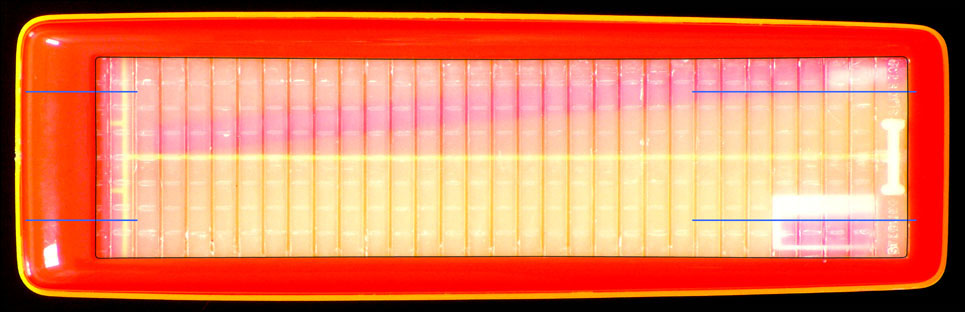
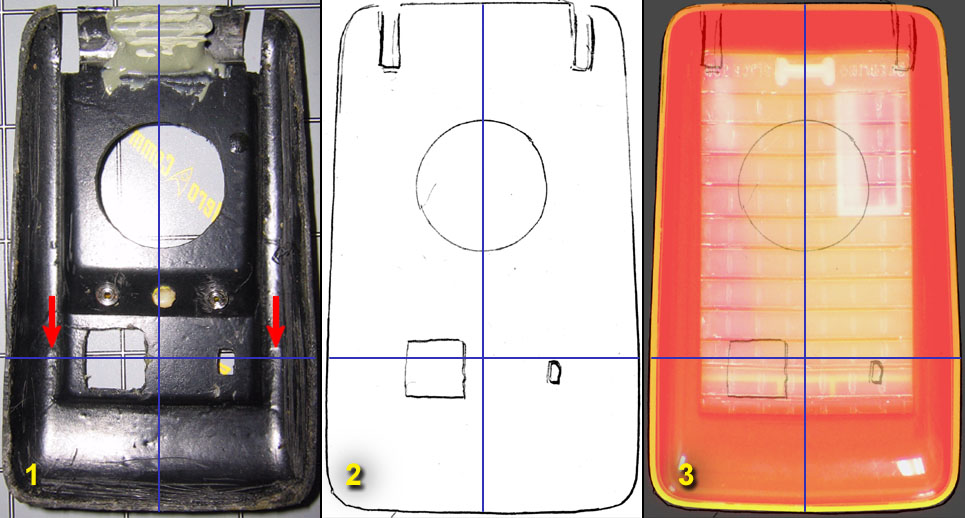
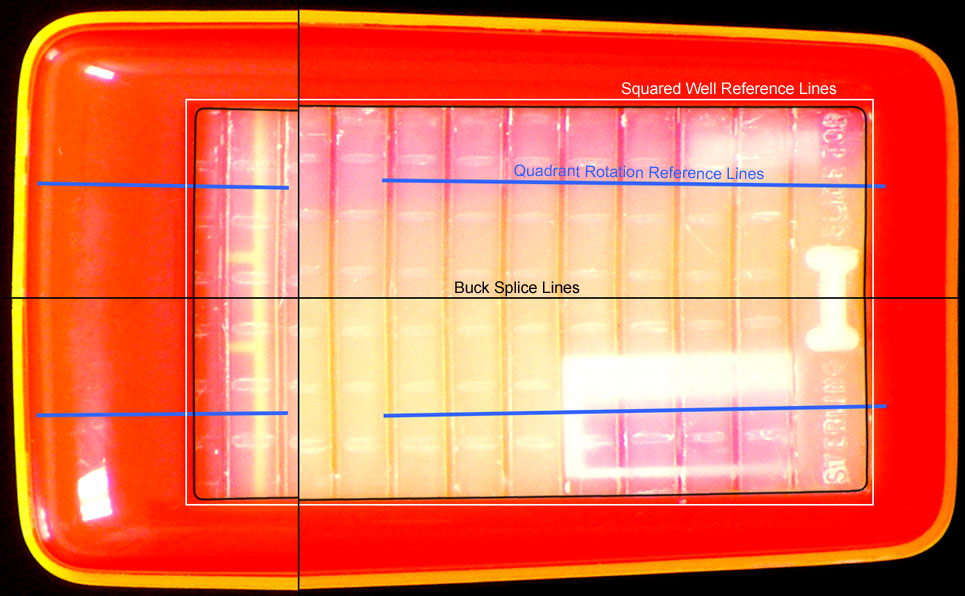
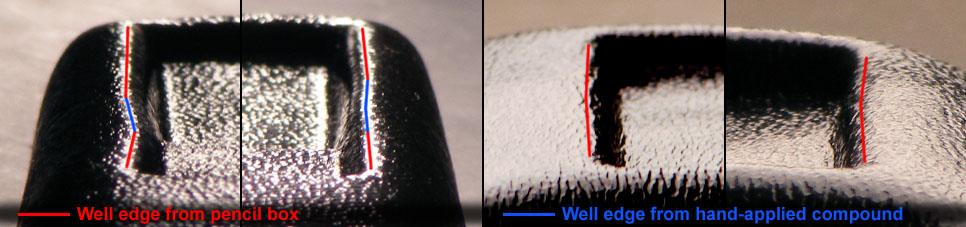
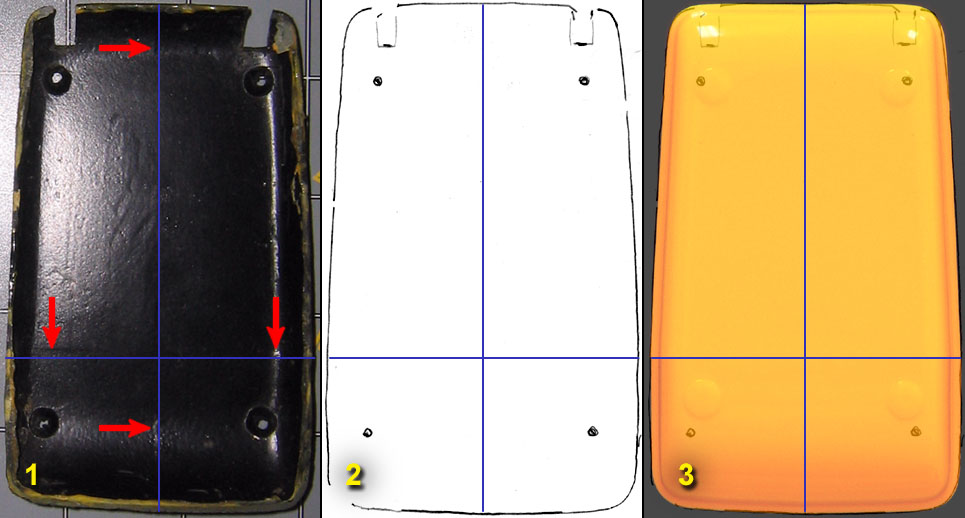
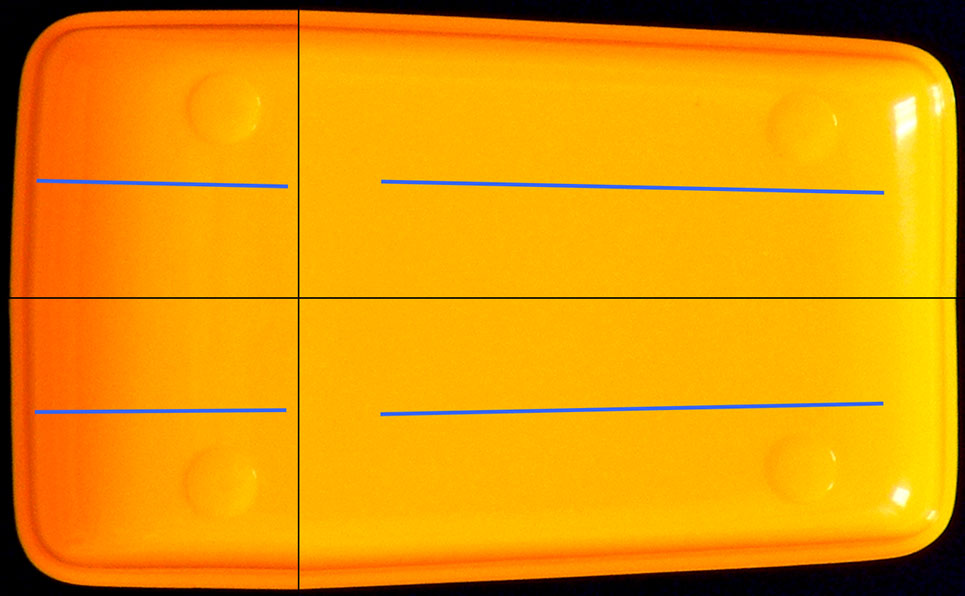
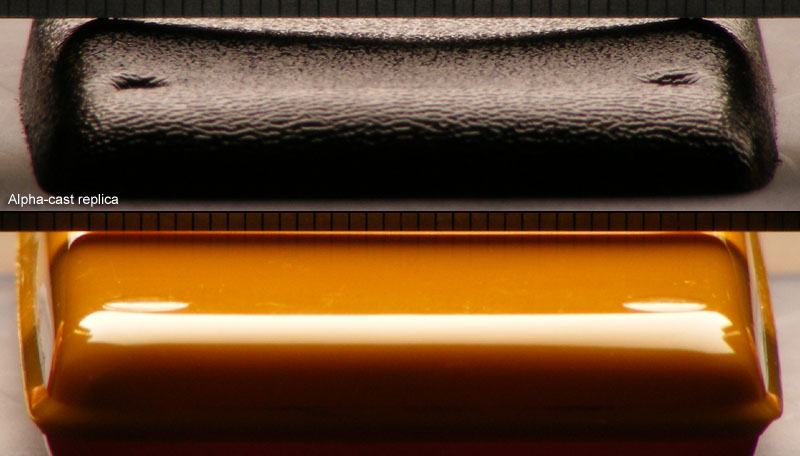
| Of great significance is how the "well" edges pinch in just a little towards the long middle and flair out at their more-supported corners. To highlight the positioning of each piece of the box within the bucks, we've overlaid for reference blue parallel lines in the four quadrants and also marked the exact edge of the well with a thin black line: We opted to match up the four corners with the shape of Zeta's top shell (below #1, reversed for continuity) since we have an actual tracing of that shell (#2). From all physical evidence available, we've located the seam between left and right sides to be smack down the middle and the seam between front and back to be positioned just shy of 1.25" from the front nose. These are shown by the blue crosshairs. The red arrows in pic #1 point to actual remnants of one of the seams inside the shell (they don't fall precisely under the crosshairs because the photo was not taken dead center above the shell). Lastly, in #3, the digitally sliced corners of the pencil box were placed over the tracing and positioned to best fit. We assumed an average Kydex thickness at that far edge to be around 0.045" as per several actual prop measurements, so the outer perimeter of the red top plastic is brought about that far in from the inner edge of the pencil tracing: What we see is something remarkable. Wah did not cut up and reassemble the quadrants parallel./.perpendicular to the box's midline, as anyone else would have done. Rather he rotated the four quadrants outwards by a degree or so, which served to enhance the front curve and side taper! Remember that those blue lines started out parallel. What all shakes out from this shifting and rotating is the next discovery... the true source of the well wanks! Note how both left and right sides of the well do not match up, owing to both the quadrant rotation and the aforementioned pinching in of the pencil box well edges. The difference would have needed to be made up with some manually-applied fill compound (like clay or modeler's putty) smoothed in. The composite image above also predicts the front well edge in the communicator shells would "chevron" outward a tiny amount and the back edge would chevron inward. In every instance, these predictions bear out PERFECTLY... the actual shell (or in this case a stand-in; a replica cast directly from the Alpha hero) is an exact match: A shell cast from Zeta's insides, available in a 2008 licensed kit, shows the identical buck imperfections. These traits are fully consistent in all of the original comms as seen in survivors today as well as in screencaps and good vintage photos. There is no way to know if the rotation of the quadrants was purposeful by Wah to enhance the shape or was just accidental. No opinion can be factually supported either way at this time, though thinking highly of the fellow as we do, it is nice to imagine the curious action was guided by his visionary artistic abilities. We next did the same analysis with the bottom shell (still based on Zeta): It goes without saying that the front domed "feet" on the box align perfectly with the partial circle imprints on the shell, which was conclusively illustrated prior by Dennis Stines with this demonstration. As to the rear feet, they actually were located pretty much right under where the screw hole dimples got drilled there; an act that would have obliterated most of any circle remnants that might have been left.
As you can see with the blue guide lines, it's the same deal above with
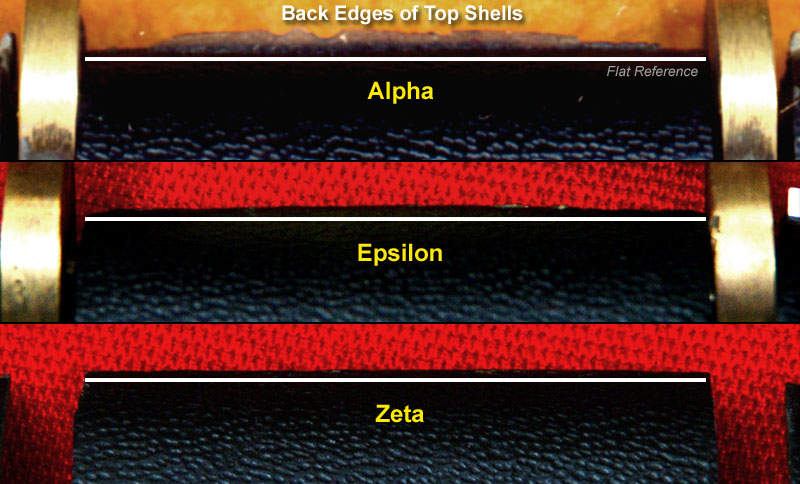
the rotated pieces. To complete the story of how chunks of the pencil box came together to form the bucks, we currently figure that Wah not only cut the box into four quadrants but also separated the top shell pieces from the bottom, which are fastened together with what seems to be just a few spots of glue. This would have allowed him to lay the pieces on a sheet of paper with perhaps drawn edge guidelines (easily mirrored for symmetry). Having both top and bottom assembled apart would also have made internal access and manipulation of the final shapes easier. Then he added three sloped surfaces for the insides of control well. Those might have been little blocks of wood inserted into the hole, or perhaps one small rectangular piece of sheet metal bent in two places. The means by which Wah held all these assorted parts together with enough strength to mold them in plaster will likely never be known with any confidence. Options range from scotch tape to hot glue to clay to a mechanical jig (or some combination thereof). Perhaps future experiments will narrow the possibilities. To wrap up, some patching compound was applied here and there to fill in the well sides and level some misaligned edges. The final assemblage of what we are calling his "proto-buck" would have looked something like this: These completed proto-bucks would have been coated with a non-stick substance (like vegetable oil) and pressed into a small batch of wet plaster until it hardened. At that point the plastic assemblage would have done its job and could be discarded. The plaster molds of the proto-bucks would have gotten their own coating of non-stick and then more plaster was poured into the negative holes. The positive forms that were pulled out would have been the actual forming bucks used on the vacuum bed with the Kydex. For clarity, we will call those from this point forward the "plaster bucks." At this stage it's doubtful Wah conducted any further clean-up of the plaster bucks, given all the bumps and pits on their outsides that ended up being impressed into the shells. * * * * * * * * So, does the pencil box sourcing explain everything about the exterior of the bucks and the shells? Well, no... at least not yet. Let's look at two places. The first is the back shell edge between the hinge wheels. If rotating the box quadrants enhanced the curve in front, then it would stand to reason that the curve in back would be commensurately diminished. The large assembly photos above even suggest that the back edge might end up straight across or even slightly concave as it touches the midplate. Here is what we do see in Wah's comms; first the tops: Then the bottoms: Is there a concave perimeter anywhere? Nope. Instead we see the ever-so slightest of an arc outward. So where did this convex edge come from? We figure Wah needed to apply some joint compound to smooth the seam between the left and right sides of the pencil box, so perhaps that smear extended the full width, bulging out the middle a smidge. Secondly is the perplexing dip seen in bottom shell's large flat surface in two of the surviving comms. While it slumps to a maximum depth approaching 1/16" in Alpha and a bit less in Zeta (remember though that Alpha's bottom shell also shows some extra heat distress that occurred after the show), there is no significant corresponding droop in the pencil box: Only three mechanisms could cause this... 1) the plaster buck itself settled in the middle while still not fully hardened (not too likely), 2) the bottom shells sagged there right after being taken off the buck before cooling, or 3) the sagging occurred after production from less-than-optimal storage conditions. The first option would mean each and every shell would have the same amount of deflection, while the second and third would have every one being slightly different - with maybe some even having none. Our money here is on Option 3. Recall what Bob Justman and Herb Solow wrote about an incident after the show's cancellation, "Props and set dressings were stored in the old RKO construction mill on the 'Desilu side' of Paramount. Months later, unknown individuals broke into the 'mill' and illegally removed many of the props..." So imagine if you will the communicators all stacked atop each other with maybe other things heaped on them as well, all cooking for months in an non-air conditioned shack in the L.A. sun. Might some of the shell creeping observed on the surviving comms have occurred then? It seems a reasonable possibility. Only further study of the Epsilon, Delta or other future finds might start to resolve this question with certainty. |
|
| An enormous "thank you" goes out to Greg Schnitzer for the wondrously generous gift of his pencil box. |
|
| Star Trek is a Registered and Copyrighted Trademark of Paramount Pictures. All Rights Reserved. All subject matters referring to Star Trek are trademarks of Paramount Pictures. This website has not been produced or endorsed by Paramount Pictures. Any material belonging to Paramount’s Copyrighted Material that may appear on this site complies with fair and/or acceptable use for the purposes of review, study, criticism, or news reporting. |