|
| |
 ... A Rare Radio Speaker Mesh Confirms
Alpha
... A Rare Radio Speaker Mesh Confirms
Alpha
|
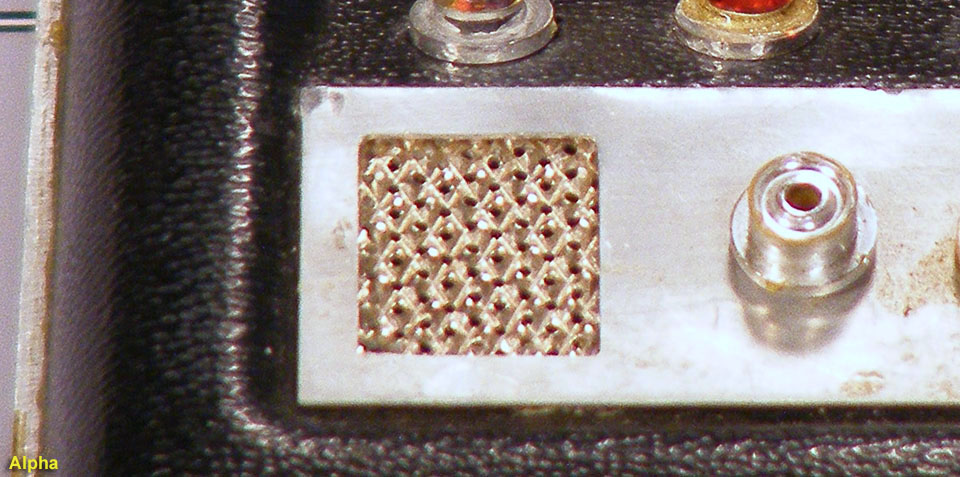
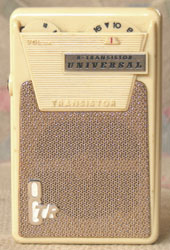
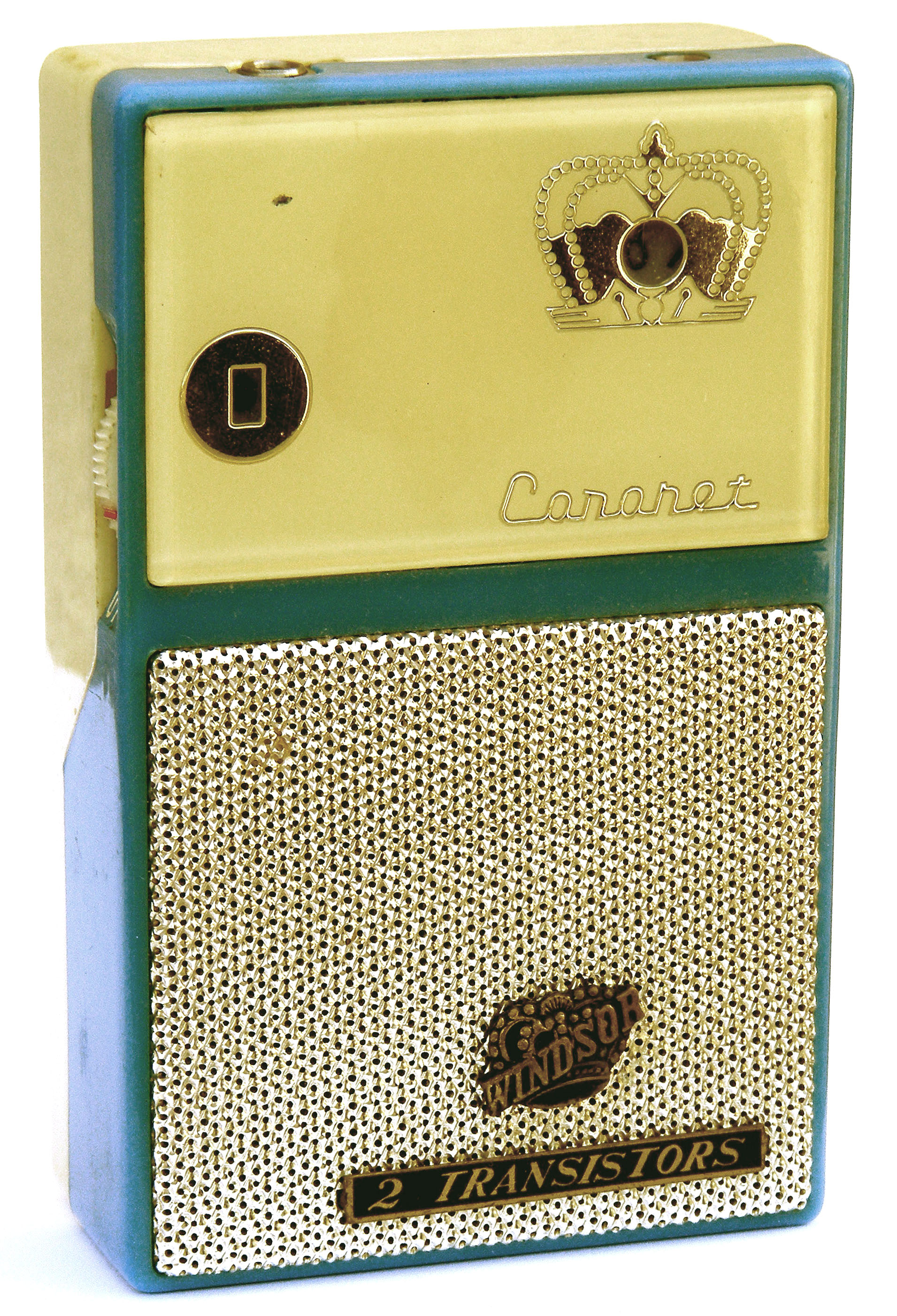
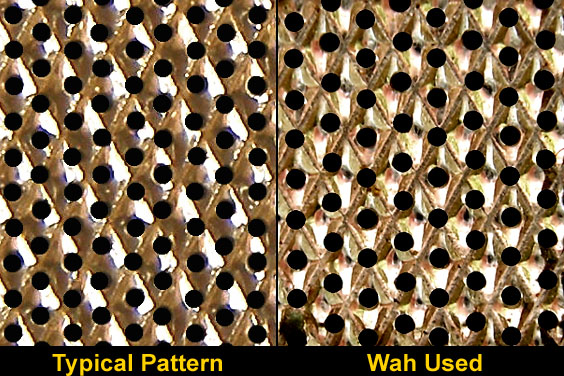
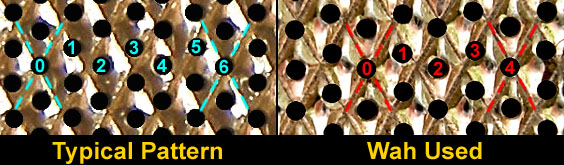
A surprising discovery has been made by our staff regarding a small and previously unassuming element of the communicator prop, the microphone grill (or "mic grill" in hobby parlance), that 1) allows you to make ever-more accurate replicas, and 2) demonstrates yet again without any ambiguity the assured authenticity of the the found Wah-built Alpha hero: How could we possibly know such a thing, given the hundreds of radios that had the diamond mesh? Because the speaker material in Wah's communicators is a different type than what's found on the Universal, Candle, Omegas, or for that matter 99.9% of all diamond-meshed vintage models. And what is this clear-cut difference that has eluded detection by all other prop experts for all these years? Simple actually, once you know to look for it. The hole spacing. Observe: In
both pictures above, the embossed diamond pattern is at the same scale.
Only the density of the holes is different, with the Wah-used having
a slightly greater spacing between each. It has taken the HC staff
considerable time to identify, obtain and study samples of this unexpected
element. So tiny are these features in real life, the big question
is: can this difference be easily quantified? Answer - yes!
Here's
how to tell what you've got: 1)
Arrange the diamond pattern so it runs long-ways up/down, 2)
Find a hole anywhere that lands on an intersection of the diamond grooves
(or maybe centered on a diamond peak), and 3)
Count how many hole columns left or right
it takes for another hole to land on a similar intersection (or peak
if that's how you started). If it repeats
in 6 rows, it's the commonplace wrong stuff. If however
it repeats in only 4, BINGO! You win. As demonstrated in
a slice of the picture above, "0" is a hole where the counting
begins and the "1" through "6" are the holes in
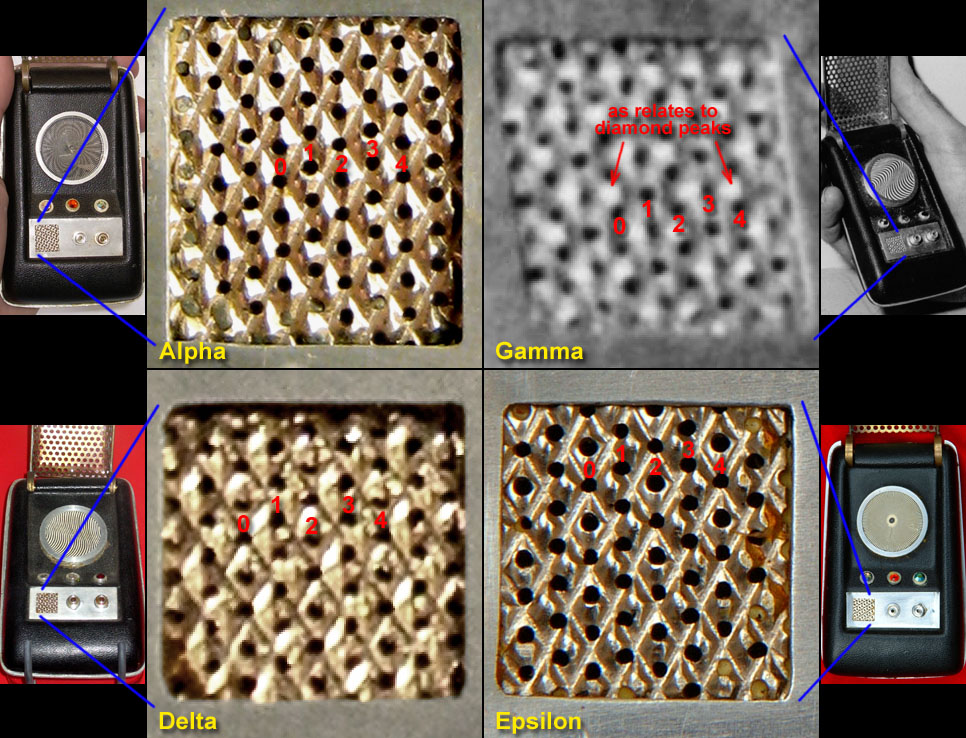
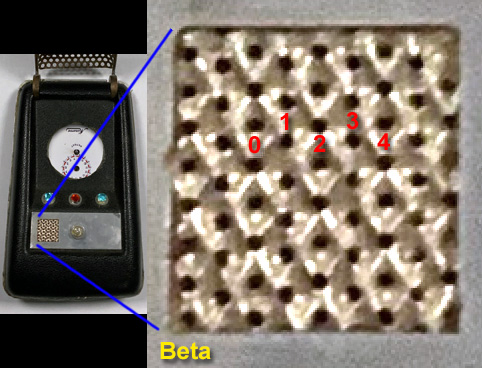
adjacent columns: It cannot be imagined why this odd variant ever came into being from the vendors who supplied the stamped metal to radio manufacturers, and do be aware that there are yet more oddball hole arrangements and spacings out there, including one with an even greater hole-to-hole distance and another with parallel rows/columns instead of the usual staggered. As to why Wah used such an uncommon radio speaker mesh, it must simply have been what he had by chance lying around to strip down. However, what this ultra-rare selection in 1966 granted us at HeroComm when it was first discovered during our 2007 Alpha blueprint efforts (the hero tracings didn't match a pre-drawn grill from a Universal) was to see yet one more absolutely unmistakable tell in Alpha that is unique to only true authentic Wah-built comms. To illustrate this, below are grill photos from five known originals with the "horizontal hole-count test" superimposed. Note how it works out perfectly in every case:
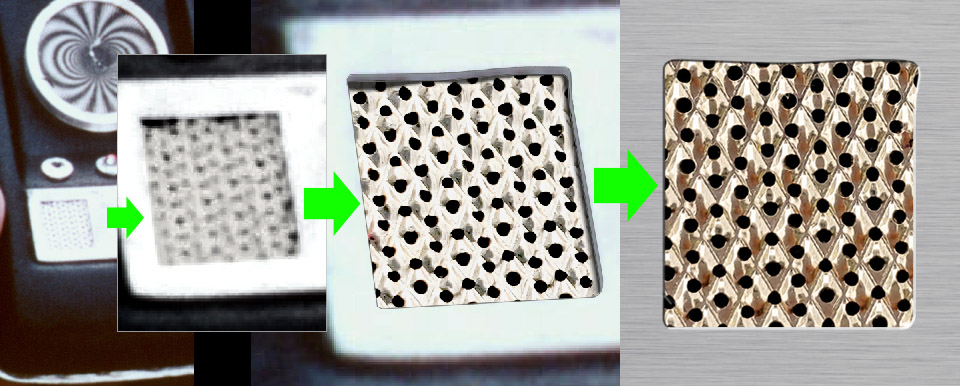
With this known, it's then actually possible to discern the precise pattern in other (still missing) comms, even when seen fuzzy and distant, based on the distinct "fingerprint" of how each patch of the radio mesh looks. So here's Gamma's in the flesh:
And Kappa:
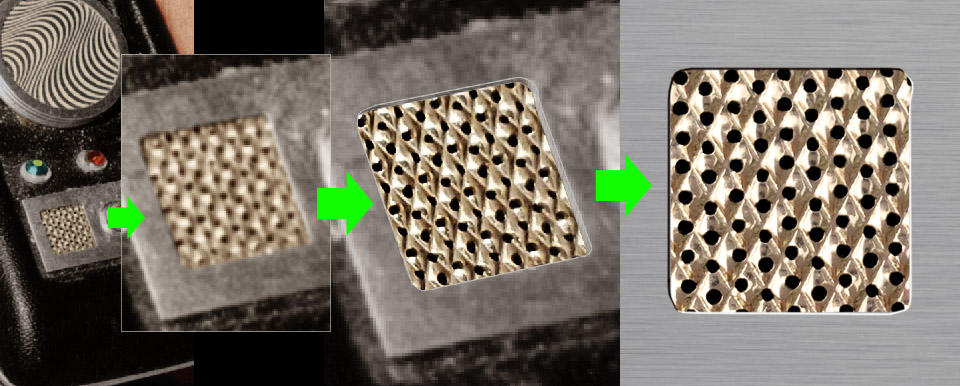
It should be noted that Kappa's appearance at the end of The Omega Glory proves all by itself that the communicators had the "4-Hole-to-Repeat" mesh; this because as the comm is tilted up when opened...
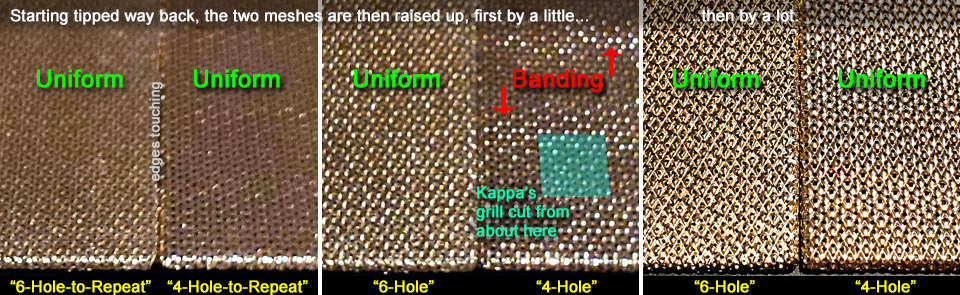
... the diamond peaks at the bottom of the grill material (at the top in these images, since the prop is viewed inverted) light up before the peaks near the top edge. This happens only in the "4-Hole" mesh due to an asyncronous spacing of the holes vs. the embossed diamonds (the "6-Hole's" spacing is syncronized). As per our test below, where we put a sheet of a "6-Hole" radio mesh next to a "4-Hole" and raised them at the same angles, both grill types can look nearly uniform across their surface when viewed either tipped far back from a light source or when straight on, but in-between the "4-Hole" mesh displays a banded moiré pattern that's exactly like what's seen in "The Omega Glory" shot:
|
| Star Trek is a Registered and Copyrighted Trademark of Paramount Pictures. All Rights Reserved. All subject matters referring to Star Trek are trademarks of Paramount Pictures. This website has not been produced or endorsed by Paramount Pictures. Any material belonging to Paramount’s Copyrighted Material that may appear on this site complies with fair and/or acceptable use for the purposes of review, study, criticism, or news reporting. |