|
| |
 ... Screen Capture Quality
|
This page goes WAY back to about 2010, but it's kept around for some basic information, and for nostalgia. |
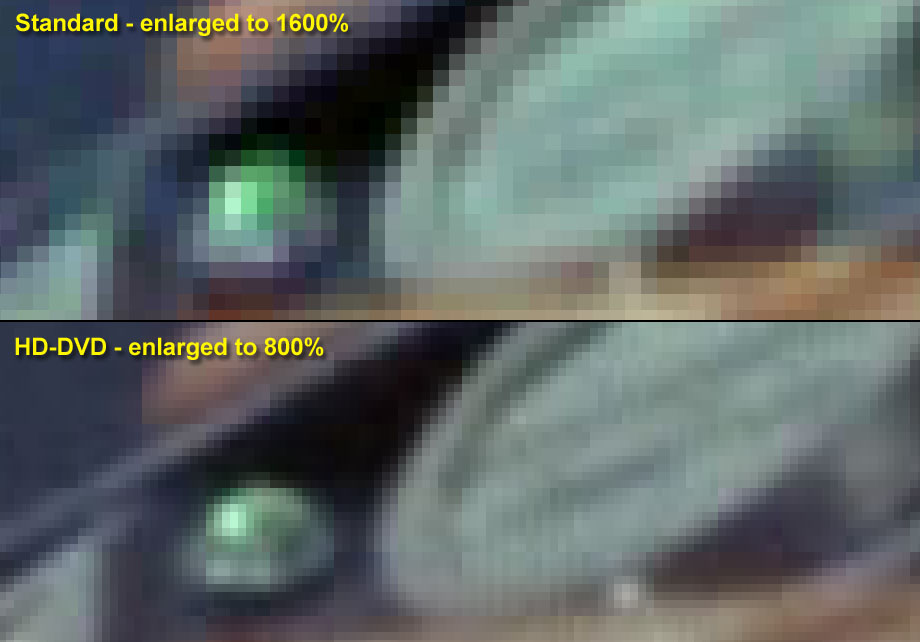
We've also seen the "maximum" that can be obtained with high definition compared to standard DVD. Simply put, when it comes to resolution, or the amount of raw data contained, there is no comparison... high def blows away standard. By how much? For every one pixel on Standard, HD delivers 4.5. That is nearly half a magnitude improvement! When astronomers get that kind of step up from a new telescope, they discover galaxies. Let's talk basics. Standard DVDs save their data as 720 pixels wide by 480 high per frame (below left). That's all you get; 345,600 "native" pixels. This format is called 480p; 480 for the height and the "p" for Progressive scan, simply meaning each line is refreshed after the last one (the other kind is "i" for Interlaced, where every other line is refreshed like in older TVs). However, since that native image has an aspect ratio (width / height) of 3:2 and a TV set has an aspect ratio of 4:3, a Standard DVD image has to be stretched vertically to be reconstituted into its proper shape, which is 720 wide by 560 high. Your DVD player will automatically do this, but no extra data is created (below right): To contrast, BluRay frames (stored in 1080p format) are 1960 pixels wide x 1080 high. That makes for a whopping 2,116,800 pixels. But that is for wide-screen movies. Again because TV is at a 4:3 ratio, BluRay cannot make use of the full width, so it only gives you 1440 pixels (1080 divided by 3 times 4). The unused portions end up as black bands to the left and right. That makes each frame of a classic Star Trek episode displayed at a still-impressive 1,555,200 pixels. As said before, that is exactly four and a half times more than Standard. Below are portions of the same frames from Miri illustrating just how much additional detail is now available to us. Note at a minimum here how nearly every antenna hole in the HD version can be made out separately: Enlarging a portion of each reveals the true detail we want... plus the undesirable artifacts from the digital compression used to reduce the file size on the disc: Wow! That sort of says it all. We hope for a few nice discoveries as all the episodes get explored in high definition. |
| Star Trek is a Registered and Copyrighted Trademark of Paramount Pictures. All Rights Reserved. All subject matters referring to Star Trek are trademarks of Paramount Pictures. This website has not been produced or endorsed by Paramount Pictures. Any material belonging to Paramount’s Copyrighted Material that may appear on this site complies with fair and/or acceptable use for the purposes of review, study, criticism, or news reporting. |
 For
obvious reasons, we at HeroComm are always keen on finding the biggest,
bestest screen cap images to base our research on, and sure enough Paramount
keeps us on our toes with their continued new releases. Most recently
has been their remastered Seasons Two and Three on BluRay DVD.
A few years ago it was the remastered Season One (>>) in HD-DVD
format. Prior to that was the four-episode-per-disc repackaged
DVDs, and further back still was a two-episode-per-disc collection that
our screen cap library was taken off of. The re-mastered DVDs
available now boast, besides a nice CG Enterprise, filmed images that
have been taken directly off of the original negatives, so at a minimum
truer color and frame size is promised.
For
obvious reasons, we at HeroComm are always keen on finding the biggest,
bestest screen cap images to base our research on, and sure enough Paramount
keeps us on our toes with their continued new releases. Most recently
has been their remastered Seasons Two and Three on BluRay DVD.
A few years ago it was the remastered Season One (>>) in HD-DVD
format. Prior to that was the four-episode-per-disc repackaged
DVDs, and further back still was a two-episode-per-disc collection that
our screen cap library was taken off of. The re-mastered DVDs
available now boast, besides a nice CG Enterprise, filmed images that
have been taken directly off of the original negatives, so at a minimum
truer color and frame size is promised.